Showing posts with label Business. Show all posts

Sunday, June 27, 2021

Build something that matters

The most highly funded startups by state.


Years ago I wrote an article about building something from nothing.  Years later that doesn't cut it. It isn't enough to just build something. You have to build something significant and profound.

There many startups at Carnegie Mellon University, the world's leading institution for artificial intelligence. When you talk to the people building them, you'll quickly realize that these people rarely think about the business - they are thinking about the technology. These companies consist of a magical sensor, a web of sensors, or stream of data. These companies assume that customers exist who need such magical sensors. Sometimes it is true. Sometimes people really do need that missing piece of data. But many times, only one person needed it. 

Designing the business is altogether different. In many ways, a great business doesn't require a great technology. Often the business model is really old.  Buy low and sell high. Information arbitrage. If you can find the business model that has always worked then accelerate it with novel technology, it will probably work. Why? Because people are usually getting something they can't get somewhere else. They are getting something special. The transaction is faster, but the product actually matters.

So do that. Build things that matter.

Thursday, April 15, 2021

Emergent startups and concrete production

 I started working at the age of 14. I was bagging groceries and stocking shelves at the neighborhood grocer. The place was kinda gross. Weird things happened. The butcher stole steaks. The stock boys smoked cigarettes behind the building. People slept in the doorway overnight. Daily, I'd have to wander the neighborhood searching for shopping carts, folks had used to transport their groceries home. But we all knew who the boss was. Ken. Ken was a bulky man with a larger mustache. He was in charge. It was a messy franchise, but it was his messy franchise, and he let you know it. Paid only $4.15 per hour, I worked my heart out for him. 

As an adult, I've encountered many organizations including tightly coordinated military units, massive enterprise software providers, high tech cost centers, and horizontal startups.  The last one, the horizontal start up, is tough.

For a long time, I figured horizontal was everything. I tried to practice it too. But I learned through trial and error that many this approach is the result of uncertain leaders. Individuals who never had to lead diffuse their power through others. Sometimes it works, sometimes it doesn't. 

When it does work, it is because you have the best talent on hand. Those individuals know how to mobilize, coordinate, and get things done. It works well.

When it doesn't work, it is because the talent isn't there. People work in shadows. People talk too much or not at all. Projects never have a clean end, but sprawl and never get truly finished.

Either way, a company must have the ability to draw a line, to a diagram, end to end how the widgets get fabricated. Maybe Ken designs it. Maybe the team stumbles until they figure it out. Either way, the company is only getting started when there is  visible, universal alignment on the widget making.

If the process is only in your head, trust me, it is only in your head. Get drawing.

Friday, March 12, 2021

Design Comes First for High Tech Entrepreneurs: Quantum Computing, Robotics, Artificial Intelligence, BioComputing, Machine Learning


The article was initially published on 7/26/17 at www.humanitarianspace.com. It has been relocated here for continuity. 

While the design is increasingly central to the operations of established technology companies, it remains overlooked within research teams pursuing initial research of those same technologies. This is due to the lack of understanding held by high tech entrepreneurs about the role of design. They think it is decoration - when in truth - it is the fundamental process to transform abstract ideas into new realities. Design is the cornerstone to successful entrepreneurship.

In the last few weeks, I have had conversations with dozens of high tech startups that have one foot in the lab and one foot on the path to a new market. Interplanetary robotics, quantum computing, and super intelligent machines are exciting new domains described at length in business and technology magazines alike, yet these ventures struggle to overcome the leap from research in unstructured domains to generating meaningful human-product experiences and viable companies. They struggle to think and work like designers.

How Design Serves Advanced Technology Companies

Computers are everywhere. As more of our lives are inundated with computers - cars, planes, banks, security, government - the software on those computers is getting very sophisticated and difficult to test. It is also difficult to build to ensure that it is testable. Think of the complexity to manage all air flights in a country, the testing of that software is critical to everyone's safety - but with so many airplanes, airports, satellites and so on - how do you test it?

In my engagement with machine learning companies throughout Silicon Valley and Pittsburgh, I found one that has solved this problem. They build tools to help other big companies build reliable software for complex systems.  They can even predict if your company is going to create a bug before it happens. It is incredible.

The company does amazing work and is profitable. Yet they have a terrible website. They know it. Their tools do not really have a user interface that users enjoy using or easily understand. Their software is very advanced and difficult to communicate.  It is challenging to hire for this company. They see every market as possible and yet are not sure how to access them. Their work is in such high demand they are doing well... but will this always be the case?  What are the limits of their current market? How do they know?

Upon offering to help with the website, I've since had multiple conversations with the founder of this company. I understand the technical details of their software. As a researcher, I am equipped to study and understand the problems they face. I also am a designer so I am able to communicate it to people who do not understand.  Consequently, as a designer, I also have methods to rapidly TEST & LEARN from the range of possible consumers on how to tailor the language, the product, and the transaction. We do not, consequently, have to worry about marketing or even business development. With design, we can KNOW and VALIDATE our language, our image, our transaction, and our team to transform machine learning into highly needed customer solutions. With Design, we can better engineer success, not just software.

This is Different than The Current Business Models and Operations

At each startup, the conversation unfolds the same way every time.  I ask about the product and the CEO demonstrates or describes the product. I ask about the business and they display a prepared document or slide deck on the business strategy and organizational shape.  I ask about financing and they tell me about early mistakes made impacting future financing for the negative. I ask about the distinction between the market they set out to pursue vs the market opportunity they have discovered - and they start to get depressed.  I ask about new market or growth opportunities, and they say "we hope to figure that out soon... " and perhaps "if only we could hire the right person for business development."

Hire the right person for business development?

Certainly, the most important aspect of building a company is the team. Yet to assume that the success of the business - to align internal operations to market demand - is the job of a solo individual is misguided.  MBA programs tout the ability to transform graduates into such beings - and there are many times this person can hold an instrumental role - but for highly sophisticated technologies, there is no evidence that a traditional business approach will always work.  To make the assumption is high risk.

In addition, when I ask "do you have a designer?" - the CEO confuses my question, thinking I asked: "Do you have someone to make this pretty?"  They say no or "that is important, but we aren't there yet" or "we know it needs to be attractive so we outsource that, we have someone make it look good." The worst ones point to their current success and say "we don't need a designer, we are doing just fine" and months later are panicking because they had all along been meeting the needs of only one or two clients and could not actually scale their business. By their definition, to have a designer on the team is expensive and the person would sit around most the time with nothing to do. If they learn their lesson - it is often too late.

Design Driven Business is an Optimized Transaction

Every company requires some basic components - they need the product, they need an efficient way to generate the product, they need a clear path to connect to the consumers for the product, they need a very simple mechanism to exchange the product for capital, and they need the ability to do this over and over again.  If this process is well tuned, the capital acquired will outweigh the capital exhausted and the company can flourish.

Nothing in this product demands marketing, or branding, or financial planning. There is no need to hire agile coaches or communications consultants. I also mentioned nothing about aesthetic design. These things - these tasks - are simply tools to help solve the core problem: the material transaction. The material transaction is made possible by the optimized movement of information. It is possible to invest in these things to make that transaction happen, but within an unknown market for an untested product, operating on the thresholds of possibility... it is difficult to measure the effectiveness of these tools. Marketing language, targetted advertising, and agile product development are all just attempts to optimize the movement of information. Yet with advanced technologies, early wins are just as likely events of luck. There is no way to know.

Design is the Process to Optimize Transactions

Designers are specialized in the art of communication. This communication may take place through graphic text, plastic form, or even through the process of a work itself (this is where the post-its come into use). Optimized communication within a team will increase efficiency, to transform a team from thinkers to doers but with less technical debt.  Optimized communication to external consumers will get the two groups together faster for the transaction to take place.

Optimized design of the transaction itself - a form of communication - will result in high satisfaction for everyone.  If transactions are fast and positive, and communication from the buyer can connect to the team (who internally is optimized to leverage it by communicating), the transaction will take place again.

You can call this stuff strategy, marketing, team building, communications, - whatever you want. But to get from lab to market - you are better off to optimize your business by starting with Design.


Wednesday, January 6, 2021

The PhD Design - Should you do it? How to make it work for you.

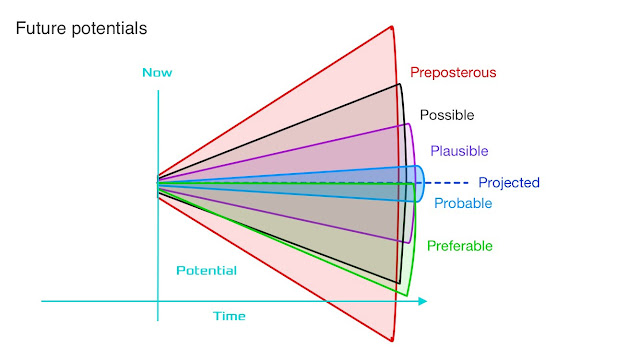
Future Cone
The Future Cone: A core concept in design theory on the impact of design to drive change [Source]


In August 2014, I began a PhD in Design and completed it in May of 2020 at Carnegie Mellon University. I did the program full time and worked full time throughout. I am also a father.  Both of my children were born during my time in the program. From 2016-2018, I formally left the program for two years while working for the White House but I continued to work on the dissertation at that time. No doubt, I was very tired and stretched too thin.


I pursued this program with a goal to expand my personal practice into new directions and to reinforce my longstanding history of connecting technology design to economic development. I expected it would lead to a combination of teaching and entrepreneurship.  I encountered deep departmental resistance to my work for reasons I never quite understood. Consequently, I very much had to complete my thesis under great stress and with limited channels of constructive feedback. Yet I achieved all of my goals. Over the years I built companies, products, and unique expertise on AI product design. I am glad I did the PhD Design. It was not a waste but it was not what I expected.

Bottom line up front, should you do the PhD design?
At the end of the day it provides a credential, so will you benefit from this credential? I benefit because I immersed myself into communities and research efforts beyond my department and across the university. I worked on a corporate research contract with the CMU Robotics Institute, which is the world leader in its field. I collaborated with persons at MIT where I also served on an investment board. The name recognition, access to resources, the growing community of friends and colleagues, and exposure to writing on design from over the last 100 years had powerful outcomes. Overall, I accomplished my goals.

At the same time, you don't need need a PhD to do much of that.  The PhD provided opportunities but those paths were not the lone options available. The culture of many PhD programs is total nonsense. Most academic faculty can't help you do anything but encourage you to be just like them. As reported by Bloomberg, there is only market demand for technical PhDs.  So I benefit because I persevered since my goals were to build a technical community, technical expertise, and to build companies. My goals aligned with the market and to create more career options. The PhD credential itself has minimal value unless I seek a teaching position in the future. So if you are interested in the PhD Design, you need to decide what you want first, assess how your goal aligns to the rest of the world, and then decide how to use the PhD experience to make that happen.

If you do not craft clear goals, or if those goals have no value to others, the PhD design will have nominal benefit - or worse, it could be a problem. It is a young degree and few people in the world have one. Individuals around the world hold deep subjective ideas about what Design is as a field. Many people think I decorate houses or design cars. Many engineers think that design is simply a matter of making things pretty or is a tool for marketing. Consequently, you need a very clear plan for using the PhD and proving your value.

Why I did the PhD Design
Prior to the PhD, I had worked in or studied several fields of design including communications, architecture and urban planning. I specialized in working in conflict cities and with displaced, refugee populations. Around that time I also maintained a blog called Humanitarian Space reflecting the previous 8 years of personal practice and published an article on choosing graduate programs. I primarily identified as an urban planner, but with a growing interest in new technologies, sought a PhD program to not just review traditional urban planning subjects. I imagined new planning problems were ahead as robotics and machine learning became integrated in society. The PhD Design seemed like a new way to think about these kinds of problems. There were only a few schools in the world where I could really do this kind of research.  I chose the PhD Design program at Carnegie Mellon University because it had a "practice based" curriculum and CMU is the global leader in AI and robotics, and the low cost of living in Pittsburgh. In comparison other top universities in the US and Europe are in more expensive cities.


What is the result of the PhD Design?
For Others - Among my peers from within my program and graduates of other PhD design programs, most are faculty at prestigious universities. They are paid a modest salary as assistant professors at globally top ranking schools, at around $65,000 USD per year. Most faculty I know make between $65,000 and $85,000 USD annually at the world's greatest universities. They are required to teach 3-5 classes per year and demonstrate evidence of other scholarly work or creative practice. Most are not required to bring in additional research funding. Those who do bring additional funds typically earn more money. A couple others are Design Researchers at a big tech companies on the West Coast. They all care a lot about a handful of academic conferences called Cumulus. They publish in niche academic journals like Design Methods and She Ji.

My Personal Experience - It is normal for goals to change over a PhD program in the US. Mine did not, but they became more specific. I had two children and thus became more concerned with the business of my practice. I also became more specifically interested in particular forms of machine learning as an emerging technology.  From my two years at the White House,  I became focused on combating disinformation as a technology entrepreneur.

Consequently, the PhD Design was a vehicle for executive education. I entered the program as a technical expert and graduated as a business executive.  I created a niche specialization in applied AI research. This enables higher earnings while also observing direct consequences of my research in the world.  This is a creative practice to solve real problems. The degree was not essential, but it provided a platform to consolidate resources, build expertise, and assert credibility.


Should you do the PhD Design?
Design is not a study of "what was" but is the study of invention, to invent something new. Designers are forward thinkers, and consequently, the study of design should be grounded in theories on creating something new. To some extent the PhD Design does this. Readings by Herbert Simon, Christopher Alexander, Christopher Jones, Horst Rittle or Lucy Suchman do well to orient a designers' thinking on the relationship between making things and human experiences. With research, one can become a better designer for social problems, engineering problems, or otherwise. The PhD in Design could be a compelling path to creative invention. 


How to approach a PhD Design program and succeed on the other side

1. Ignore the previous work by the graduate department - what is their plan for future work?
You can review all the work that came out of the department, but as a PhD Design candidate, you will be there 4+ years into the future and the past work doesn't matter as much. Also don't stay 10 years. Just get the damn thing out the door and move on with your life.

2.  You need to get friendly with a possible advisor to get accepted but select a program by the culture.
It is common practice to email possible advisors and build a relationship before applying. Do not be afraid, it is part of their job. But you need a catchy email and a reason. That person will advocate for your admission. Feel free to engage multiple persons. But do not expect you will have a great relationship with your preferred advisor.  I came to CMU because two people on faculty were rockstars in Design and Human Computer Interaction. Then they both left. These kinds of problems are common. I continued to work with those persons, but they could not be my advisors as they were not in my department. I left the program for a couple years and when I came back it was better. I found two faculty members who avoided the politics and wanted to help me graduate. They knew what constituted a good thesis and provided the necessary support to get it done and graduate.

3. Do great work and NEVER stop fighting for what you want.
If you come to the program with specific goals, do not give up, no matter how much other people do not agree or support you. I was told that my goals were the wrong goals. I was told that my reading selections were the wrong selection. I was told that my presentations were too aggressive. I was told that a focus on business is antithetical to the values of academia. This is total idiocy. These were subjective complaints. As faculty in Design, they have a steady paycheck do not have a real risk if their practice/research endeavors fail to generate any meaningful outcomes in the world.  Unless they have done the specific thing you want to do and they are speaking to that topic - their input should be ignored. You own all the risk if your PhD doesn't work out and they have none.

4. Read number 3, again.
Seriously, no one cares about your goals as much you do. If you use the PhD Design for what it should and could be - prioritizing the creation of things that are new - then you will be alone. The more your ideas and work are truly innovative, the more people will criticize what you do and the less they will have to contribute. True innovation is a lonely road. So fight like your future depends on it, because it does. Then celebrate when you achieve the extraordinary. All the naysayers will still be stuck in the same old jobs doing the same old things. You will, however, go on to have great adventures and opportunities ahead.

Saturday, July 18, 2020

Engage the world, have a vision, build a city, now go die in it.


Building a company isn't for everyone, and for those who love it, it is an act of sadism. The impetus to build a company is rooted in deep feelings, deep primitive reactions to the world. It is founded on anger, from not fitting in, and from a desire to own your own destiny. It is not a lifestyle or a privilege or an achievement, it is an act of vengeance upon everything that is wrong with society.

Building a company is not the same as making a product. When you make a project, you take an action and you get a response. You put paint on the canvas and it just remains there. It doesn't change. It doesn't talk back. It just sits there until you push it again. As a leader, your job is to create systems for other people to succeed. You must invent systems to hire people, to give them direction, and to help them flourish. You must create systems to help people communicate, to manage each others feelings, and to make progress toward your goal. You must create systems to make them feel considered, to recognize their own visions, and to passionately work toward yours.

But then what happens? You found and inspired people with a codified approach to realize your dream. What does that become? Where does it go? After you build the ship, can you still steer it forward? If there is a challenge ahead, that might keep you grounded, it will make or break you. But what if there is no immediate threat? Where do you go? 

With or without the challenge, you will find a moment of decision, when it is most difficult to remain clear headed and you must persevere. You will find a moment where your previous methods didn't work. You won't working right. You landed the spaceship on the alien landscape and there is no oxygen in place. You try to stick to your gut, or you open you mind, either way you double-down on the direction to see it through. And then you die. There is no air. There was no lifeboat. You were alone and you died alone. 

If along the way you found others who really understand what it is like to drown and resuscitate, then maybe they can give you the right coaching. They can't make oxygen from ether, but maybe they could have told you to prepare and you listened. Maybe they were wrong and you prepared the wrong way. Maybe it all came together and you made it out alive.

Can you make it out alive? All the anger in the world is not enough to save you, and so at some point, the piss and vinegar that gave you fuel to create will ruin you. You must change. What do trap rappers rap about when they become millionaires? Many of them still rap about dealing drugs and fighting gangs. They never cross this chasm. What do great comedians tell jokes about once they told all their personal stories and stories about travel? They need a new act. Many never find one. 

Heidegger said that moments of revelation are when the scrim is pulled back, and you can see the tower on the hill. It was always there, but you could never see it. Heidegger was wrong. The tower is only there if you want it to be, and you don't pull back the scrim, you build the tower. You incentivize others to build it with you and it becomes a city.

Engage the world.
Craft a vision. 
Build a city.
Now go die in it.